
Tuesday, May 29, 2012


Wednesday, April 25, 2012
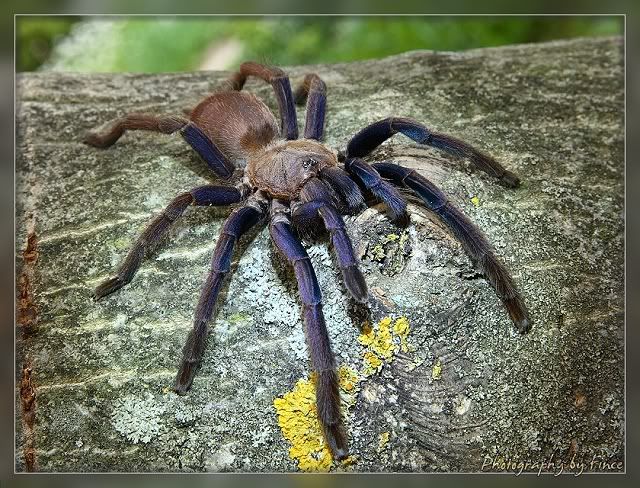
Chilobrachys sp. 'blue/south vietnam"


Tuesday, April 10, 2012
Bután tán aszitted nem lesz többé Bhutantan?


Wednesday, March 28, 2012
Tuesday, March 27, 2012
Féktelenül

Majdnem egy éve annak már, hogy erről a meglepően érdekes kutatásról írtam itt a blogon egy rövid ismertetőt. Most megérkezett arra a cáfolat is a Foelix féle csapattól, melynek rövid összefoglalása emígyen szól:
Erősen vitatható az a nézet, mely szerint a madárpókok lába képes finom pókselyem előállítására, megelőzve az állat leesését sima felületről. Két tanulmány állítja, hogy a végízeken található „recés szőrök” képesek pókselyem előállítására. Számos madárpókfajnál vizsgáltuk ezeket a szőröket fény és elektronmikroszkóp segítségével és hasonlítottuk össze őket az utótesten található fonószemölcsök szövőcsévéivel. Azt találtuk, hogy a recés szőrök felépítésükben közeli rokonságban vannak a pókok kémiai anyagokat érzékelő szőreivel (csésze alakú foglalat, hajlott forma finom hosszanti élekkel, excentrikus dupla lumen a szőrszál belsejében, tompa végződés nem egészen végállású nyílással).
A fonószemölcs szövőcsévéi nagy, vaskos alapzattal rendelkeznek, mindennemű gödör vagy foglalat nélkül. Ezek nem nyílásban végződő hosszú szőrök recés felülettel. Elektronmikroszkópos vizsgálat során soha nem tapasztaltunk pókselymet a recés szőrök esetében, ellenben a szövőcsévéknél ez nagyon gyakori jelenség. Érdekes módon a recés szőrök előfordulnak a fonószemölcsön is, gyakran a pókselymet termelő szövőcsévék mellett.
3. Ábra A fonószemölcsök szövőcsévéi a P. regalis (A,B) és a Brachypelma auratum (C). fajok esetében. (A) Két tipikusan holyagszerű alappal rendelkező cséve.(Bvel jelölve) és (mechanikus hatásokra érzékeny) szőrökkel körülvéve. (B)Több szövőcséve mellett egy bordázott szőr (csillaggal jellölve). Nyílheggyel a csévék végén a pórus léthatóvalamint az abból kilógó selyemdarabkák . (C)Közeli képek egy csévéről (nyíl), illetve egy bordázott szőrröl (csillag).
Az élő madárpókok megfigyelése a üvegkísérlet során megállapította hogy a recés szőrök állították elő valamit, de az tisztázatlan maradt, hogy ez valóban pókselyem kiválasztás volt vagy sem. A következtetésünk az, hogy a recés szőrök kémiai anyagokat érzékelnek, nem pókselymet állítanak elő. Mindenesetre a biztos tapadás érdekében, a végíz és a tapogatóláb talpecset szőreinek ezrei biztosan többet nyomnak a latba a recés szőrök ritkásan elszórt hálónyománál.
Forrásanyag annak, aki jobban rá akar kattanni a témára:
Foelix, R. F., B. Rast & A. M. Peattie. 2012. Silk secretion from tarantula feet revisited: alleged spigots are probably chemoreceptors. Journal of Experimental Biology (April 1, 2012) 215, 1084–1089.
Saturday, March 24, 2012


Tuesday, January 31, 2012
Catanduba
A közeli jövőben egy bővebb, magyar nyelvű összefoglaló is megszületik, egyelőre csak az angol összegzés.
Yamamoto, F. U., S. M. Lucas & A. D. Brescovit. 2012. Catanduba, a new Theraphosinae spider genus from Central Brazil (Araneae, Theraphosidae). Zootaxa 3172: 1–19
Abstract. A new genus, Catanduba, is proposed and supported on the cladistic analysis with the following synapomorphies: embolus tapering abruptly from half of the length, embolus tooth associated with PIK and a triangular basal nodule on male metatarsus I. Homoeomma simoni and Plesiopelma flavohirtum are transferred to Catanduba and five new species are described: C. tuskae, C. araguaia, C. piauiensis, C. canabrava and C. peruacu. The species occur mainly in central Brazil in Cerrado areas, with some species also occurring in Atlantic forest (C. tuskae sp. n.) and Caatinga (C. piauiensis sp. n. and C. peruacu sp. n.).
Monday, December 26, 2011
Új JoA – madárpókos cikkek
Shaw, E. M., S. P. Bennett & C. P. Wheater. 2011. Distribution of Brachypelma vagans (Theraphosidae) burrows and their characteristics in Belize over two years. Journal of Arachnology 39 (3): 515-518. doi: http://dx.doi.org/10.1636/P10-39.1
Abstract. To help to address the paucity of ecological knowledge available for Brachypelma vagans Ausserer 1875, a CITES protected species, we monitored a population in Western Belize for two years to provide data for distribution and dispersal. Despite previous over-collection for the pet trade, the species is locally highly abundant in some areas of Belize. We recorded the distribution, burrow and spider characteristics of B. vagans in 2007 and 2008 at Las Cuevas Research Station, Belize. Population dynamics were compared between years, as was individual location. Over 100 burrows were located in both years; however, previous assumptions that individuals do not move burrows regularly appear negated, since only 12 burrow locations matched between years, suggesting high intra-habitat dispersal. Despite this apparent high level of movement burrows were significantly clumped, to a similar degree, in both years. This movement could be due to disturbances throughout the year, including flooding during the rainy season. Burrow size correlated with individual body size, except in a few juveniles that appear to have opportunistically claimed an empty burrow, accounting for some small animals found in large burrows.
Guadanucci, J. P. L. 2011. The genus Plesiophrictus Pocock and revalidation of Heterophrictus Pocock (Araneae: Theraphosidae). Journal of Arachnology 39 (3): 523-527. doi: http://dx.doi.org/10.1636/A10-53.1
Abstract. The genus Plesiophrictus is diagnosed and redescribed based on type material and additional specimens. The type species P. millardi (Pocock 1899) is redescribed. The genus Heterophrictus is revalidated, with H. milleti as type species. Heterophrictus differs from Plesiophrictus by the absence of serrula on maxillae and by having a rastellum on the chelicerae and stiff, spike-shaped setae on the prolateral coxae I. The significance of characters used in the taxonomy of both genera is discussed.
Fukushima, C. S., F. Pérez-Miles & R. Bertani. 2011. On the Avicularia (Araneae: Theraphosidae: Aviculariinae) species from Uruguay. Journal of Arachnology 39 (3) :528-532. doi: http://dx.doi.org/10.1636/A10-12.1
Abstract. The taxonomic status of four species of Avicularia Lamarck 1818 described from Uruguay: Avicularia anthracina (C.L. Koch 1842), Avicularia alticeps (Keyserling 1878), Avicularia parva (Keyserling 1878) and Avicularia tigrina (Pocock 1903) is discussed. The holotypes and/or original descriptions of these species were examined, and two taxonomic synonymies are needed, which are presented herein. Avicularia anthracina is transferred to Grammostola, resulting in Grammostola anthracina (C.L. Koch 1842) new combination and is considered a senior synonym of Grammostola mollicoma Ausserer 1875 new synonymy. Likewise, Avicularia parva is transferred to Catumiri Guadanucci 2004, where it is placed in the synonymy of Catumiri uruguayense Guadanucci 2004 new synonymy. Avicularia tigrina and Avicularia alticeps, originally described in the genera Ischnocolus Ausserer 1875 and Pterinopelma Pocock 1901, respectively, are herein considered nomina dubia since their types are presumed lost.
Wednesday, December 21, 2011
Boldog karácsonyt
Saturday, December 10, 2011
Hamupipőke


